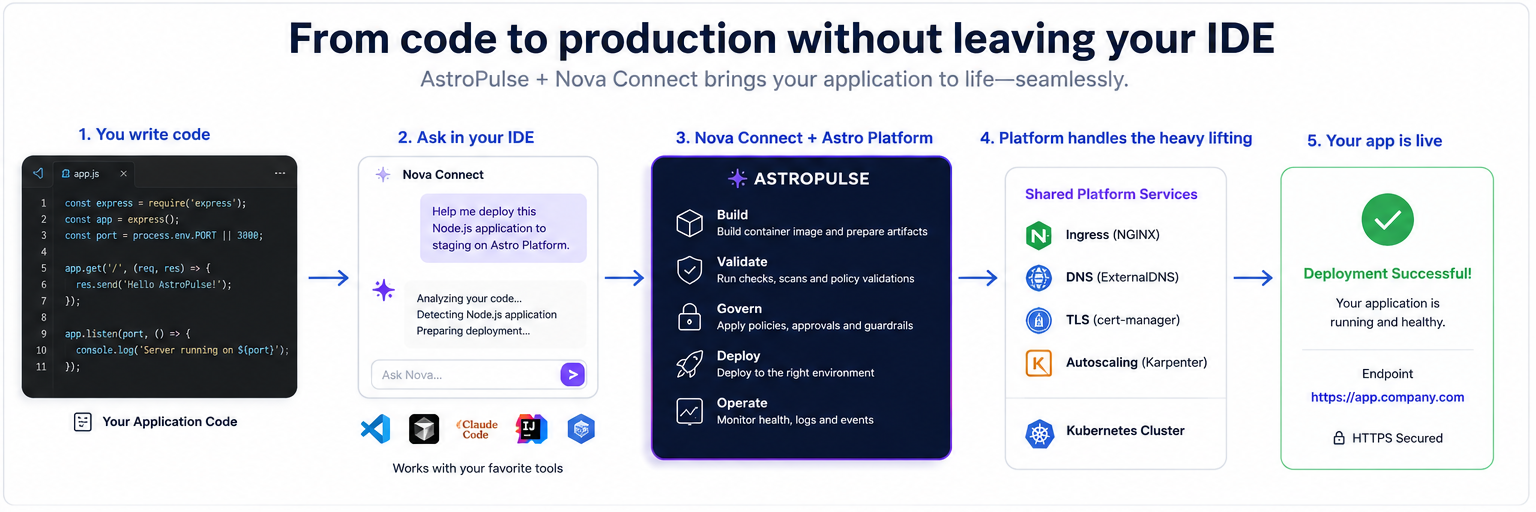
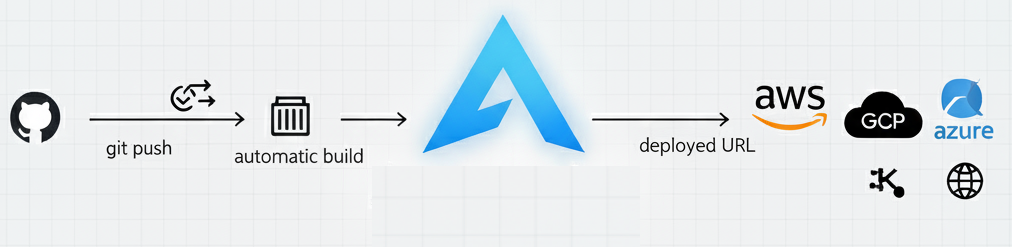
In this guide, you'll build your own Vercel-like platform on Kubernetes in ~30 minutes:
- You'll deploy an EKS cluster with kpack (auto-builds), cert-manager (TLS), external-dns (DNS), and nginx-ingress
- You'll configure automatic Git push → build → live HTTPS deployment (just like Vercel)
- You'll run any workload: web apps, APIs, databases, microservices, background jobs—any language
- You'll add security scanning, compliance controls, and observability for production
- You'll use Nova to debug, troubleshoot, and operate your platform
Perfect for building internal developer platforms, launching SaaS products, or meeting enterprise compliance requirements.
Introduction
You want the simplicity of "push code, get a live URL"—the developer experience Vercel pioneered—but with full control over your deployment, infrastructure, and compliance. This guide shows you how to build that experience on your own AWS infrastructure using AstroPulse and open-source tools: kpack, cert-manager, external-dns, and nginx-ingress.
You'll build a production-grade platform that delivers Git-push deployments with automatic TLS certificates, preview URLs, and complete observability—all running on infrastructure you own and control. Unlike hosted PaaS platforms, you'll be building on Kubernetes with full deployment control. That means you can run any workload: microservices (with or without public endpoints), stateful databases, WebSockets, long-running background jobs, AI/ML model training and serving, or traditional web applications in any language. You get the simple developer experience with complete architectural control.
How operations work: The infrastructure industry is moving toward an agentic era—AI agents autonomously handling complex workflows (MCP, A2A, multi-agent orchestration). We're heading toward infrastructure that self-configures, self-heals, and self-optimizes. We're not there yet, but Nova brings you AI-assisted operations today with human-in-the-loop. Day 1 (this guide): You build the platform. Day 2 (ongoing): Nova analyzes issues, diagnoses problems, recommends fixes—you approve. As AI matures, more becomes autonomous.
This is a comprehensive, production-ready blueprint. We cover everything from architecture to production deployment with complete working examples, security, compliance, and troubleshooting.
- ⚡ Want the fast track? Jump to our automated setup script (platform deploys in 30 minutes)
- 🎯 Looking for specific topics? Use the navigation guide below to jump to what you need
- 📚 Want to understand every detail? Read through—it's structured as a comprehensive step-by-step walkthrough