Six months in as platform lead and you have a spreadsheet you haven't shown your manager. Eleven Kubernetes clusters. EKS for production. GKE for the ML team. Two on-prem clusters behind the firewall that predate your tenure. A handful of Kind clusters developers spun up locally. Each one has its own deployment pipeline, its own credentials rotation process, its own way of answering "is this service healthy?"
Your team isn't building features anymore. You're maintaining eleven slightly different versions of the same tooling.
Every AI agent demo looks the same. The model calls a tool, gets a result, and responds. Then you run it against real infrastructure, and the demo falls apart in ways the tutorials never mention.
We have spent over a year building Nova, an AI agent that operates real infrastructure for real teams. It is not a chatbot that wraps API calls. It investigates incidents, executes remediations, and composes across dozens of integrations. This post is about what we learned: the problems that made us rebuild entire subsystems, and the patterns that survived.
Platform teams carry operational knowledge that does not transfer easily. The debugging instincts, the service interdependencies, the deployment quirks: they accumulate over years and live in a few people's heads. When those people are unavailable, the gap shows.
We built Nova to put that knowledge into a system you can query. This post covers what the architecture looks like and what we learned building AI that actually operates infrastructure.
Enterprises are discovering they can run powerful AI models on their own infrastructure—but building production AI infrastructure is significantly harder than application deployment.
This post breaks down the six interconnected systems required, why specialized small models outperform foundation models for enterprise use cases, how emerging AI agents are changing the economics, and the engineering trade-offs at every layer.
📖 About This Guide
This is a comprehensive technical deep-dive. We explore the complete AI infrastructure landscape—from why enterprises build their own platforms to the six pillars required and the open-source technologies available.
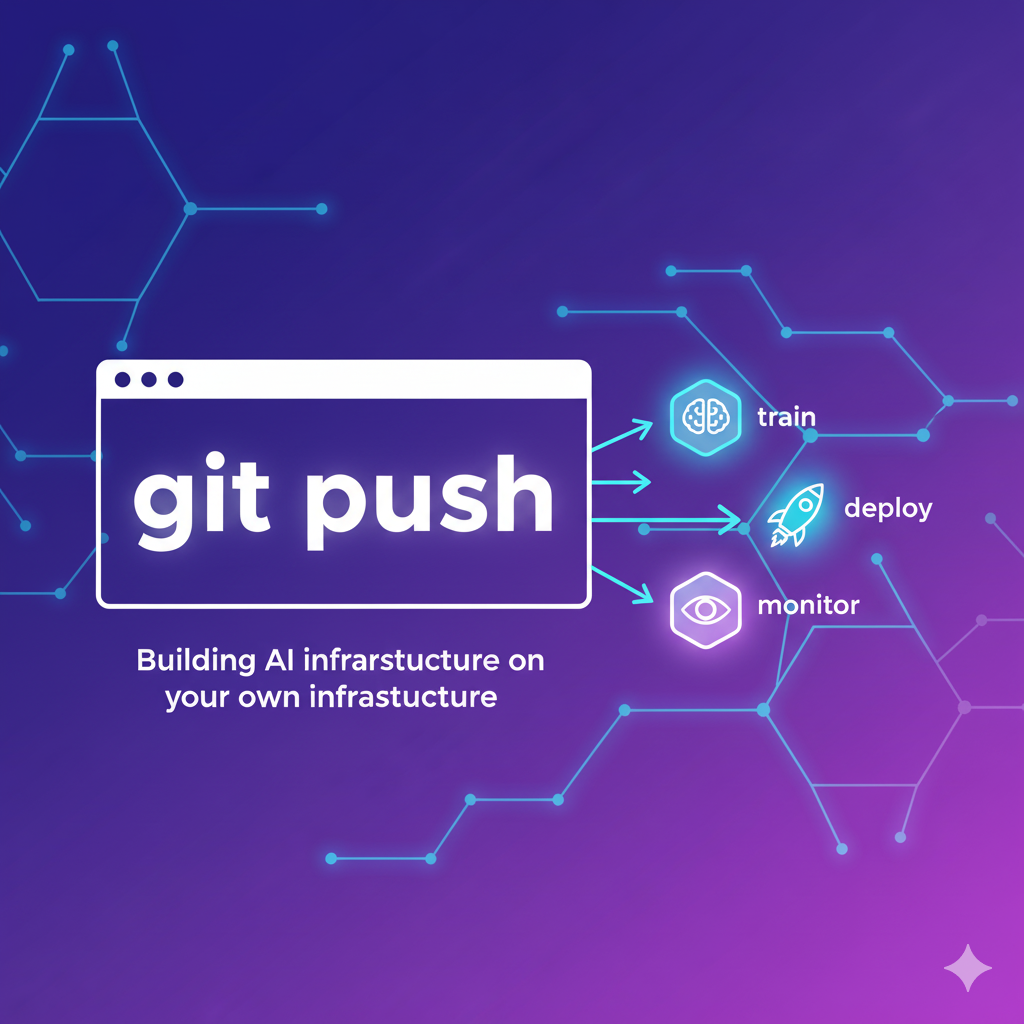
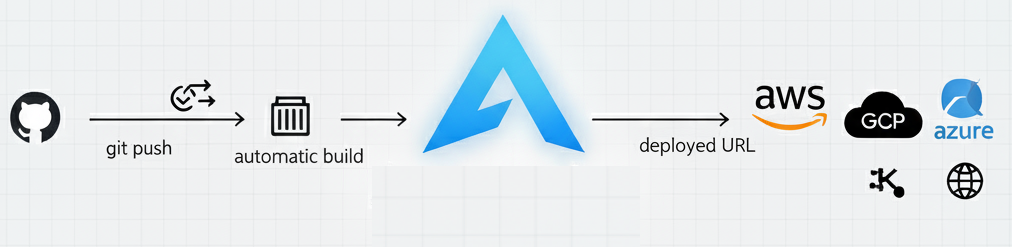
You want the simplicity of "push code, get a live URL"—the developer experience Vercel pioneered—but with full control over your deployment, infrastructure, and compliance. This guide shows you how to build that experience on your own AWS infrastructure using AstroPulse and open-source tools: kpack, cert-manager, external-dns, and nginx-ingress.
You'll build a production-grade platform that delivers Git-push deployments with automatic TLS certificates, preview URLs, and complete observability—all running on infrastructure you own and control. Unlike hosted PaaS platforms, you'll be building on Kubernetes with full deployment control. That means you can run any workload: microservices (with or without public endpoints), stateful databases, WebSockets, long-running background jobs, AI/ML model training and serving, or traditional web applications in any language. You get the simple developer experience with complete architectural control.
How operations work: The infrastructure industry is moving toward an agentic era—AI agents autonomously handling complex workflows (MCP, A2A, multi-agent orchestration). We're heading toward infrastructure that self-configures, self-heals, and self-optimizes. We're not there yet, but Nova brings you AI-assisted operations today with human-in-the-loop. Day 1 (this guide): You build the platform. Day 2 (ongoing): Nova analyzes issues, diagnoses problems, recommends fixes—you approve. As AI matures, more becomes autonomous.
📖 About This Guide
This is a comprehensive, production-ready blueprint. We cover everything from architecture to production deployment with complete working examples, security, compliance, and troubleshooting.
⚡ Want the fast track? Jump to our automated setup script (platform deploys in 30 minutes)
Platform engineering represents the natural evolution of DevOps and SRE principles, but it faces a fundamental challenge: how do you scale platform expertise across an entire organization without requiring every developer to become a cloud expert?
This is where Nova comes in — your AI platform engineer that makes infrastructure accessible to everyone through natural conversation.
The Platform Engineering Evolution
DevOps broke down silos → SRE brought engineering rigor to operations → Platform Engineering created self-service infrastructure → Nova makes platform engineering conversational and accessible to everyone.
The Platform Engineering Challenge: Scale vs. Expertise
Platform engineering promised to solve the "you build it, you run it" scaling problem by creating Internal Developer Platforms (IDPs). But even the best platforms face fundamental limitations:
👥
Expert Bottlenecks
Platform teams become the new constraint—everyone depends on their expertise
📚
Documentation Decay
Complex systems require constant documentation that quickly becomes outdated
🧠
Context Loss
Critical operational knowledge lives in tribal knowledge, not systems
⚙️
Cognitive Load
Developers still need to understand infrastructure concepts to use platforms effectively
The Core Issue
We've built self-service platforms, but we haven't solved the underlying problem of democratizing platform engineering expertise.
Nova is an AI platform engineer that helps you manage infrastructure through natural conversation. Ask questions, get answers, generate configurations, and troubleshoot issues — all through simple chat.
What makes Nova different:
Works with your existing tools (Slack, GitHub, AWS, Terraform, Kubernetes, and more)
Available however you want to work — browser, self-hosted, or in your editor
Nova's power comes from its extensibility. Connect the tools you already use:
Available Skills:
Cloud Providers — AWS, Google Cloud, Azure cost calculations and resource management
Communication — Slack integration for team collaboration
Development — GitHub for code search, issues, and PRs
Infrastructure — Terraform and Helm configuration generation
Kubernetes — Cluster management and troubleshooting
And more — Add any MCP server for custom integrations
Bring Your Own Tools
Nova Direct includes the built-in MCP Marketplace for custom integrations. Nova Connect works through standard MCP-compatible clients, so teams can bring Nova into existing editor and CLI workflows without running the server locally.
The evolution from DevOps → SRE → Platform Engineering → AI-Assisted Platform Engineering represents more than technological progress — it's about democratizing expertise that has historically been scarce and expensive.
Traditional Model
Small teams of platform experts serve entire organizations
Welcome to our technical deep-dive podcast where we explore how Astro Platform is transforming cloud infrastructure management. Join us as we discuss the challenges, solutions, and future of cloud computing with industry experts.
According to Gartner's prediction highlighted in our discussion, by 2025, over 95% of new digital workloads will be deployed on cloud-native platforms, up from 30% in 2021. This dramatic shift underscores the urgency for efficient cloud management solutions.
In today's competitive business landscape, operational efficiency isn't just a goal—it's a necessity.
Companies are constantly seeking ways to reduce costs while maintaining high levels of performance and scalability.
Cloud infrastructure management, while offering flexibility, often comes with its own set of financial challenges.
This is where Astro Platform's AI-powered solutions make a transformative difference.
The Financial Burden of Traditional Cloud Operations
Before diving into how Astro Platform can help, it's essential to understand the financial implications of traditional cloud management:
Over-Provisioning Resources: Companies often allocate more resources than needed to avoid downtime, leading to wasted expenditure.
According to CloudZero, businesses waste up to 32% of their cloud spend due to underutilization of resources.
Underutilization: Idle resources that aren't scaled down contribute to unnecessary costs. The same CloudZero report indicates that 32% of cloud spend is wasted due to underutilization.
Operational Overheads: Manual monitoring, scaling, and troubleshooting require significant human resources, adding to operational expenses.
Security Risks: The average cost of a data breach in 2023 was about $4.45 million, highlighting the financial importance of robust cloud security measures.
Astro Platform's AI Agents: Your Cost-Saving Allies
Astro Platform integrates advanced AI agents specifically designed to tackle these financial challenges head-on.
AI-Assisted Resource Management: The AI agents analyze application usage patterns and provide actionable insights for optimizing computing resources. This collaborative approach helps teams make informed decisions about resource allocation, with humans retaining control over final adjustments.
Automated Optimization with Safeguards: For less critical systems, AI can implement automatic resource adjustments within predefined parameters. This process includes human approval workflows for significant changes, ensuring a balance between efficiency and control.
Financial Impact: By leveraging AI insights and controlled automation to guide resource optimization, companies can significantly reduce over-provisioning and potentially lower cloud expenses by up to 30%.
Automated Compliance Checks: Ensures that all deployments meet industry-specific regulations, avoiding potential fines.
Financial Impact: Mitigates the risk of non-compliance penalties, which can be significant. According to the CloudZero report, the average cost of a data breach in 2023 was about $4.45 million.
Let's consider a mid-sized enterprise spending $1 million annually on cloud infrastructure:
Resource Optimization Savings: By reducing wasted cloud spend (which averages 32% according to CloudZero), the company could save up to $320,000 per year.
Security Cost Reduction: By preventing potential data breaches, which cost an average of $4.45 million in 2023, the company mitigates significant financial risk.
Operational Efficiency Savings: Automating tasks and improving resource utilization can reduce labor costs by an estimated 15-20%, leading to substantial annual savings.
Potential Annual Savings: Over $320,000 in direct cloud costs, plus 15-20% reduction in operational labor expenses and risk mitigation of multi-million dollar security breaches.
This example illustrates how Astro Platform's AI-driven solutions can directly impact a company's bottom line, turning potential losses into tangible savings across multiple areas of operations.
In a world where operational costs can make or break profitability, leveraging AI to optimize cloud infrastructure is no longer optional—it's imperative.
Astro Platform stands at the forefront of this revolution, offering AI-driven solutions that deliver significant financial benefits.